The story behind Joy to the World
Joy to the World began as a psalm, not as a carol for a Christmas pageant. In 1719 the English Independent minister Isaac Watts published The Psalms of David Imitated in the Language of the New Testament, and Applied to the Christian State and Worship. In that book his version of Psalm 98 appears under a heading about the Messiah's coming and kingdom. The opening line, Joy to the world, the Lord is come, let earth receive her king, is Watts speaking the psalm as if the promised reign had arrived. He was not writing a story about shepherds or a manger. He was doing what he had set out to do years earlier: sing the Hebrew psalms in explicitly Christian words.
The tune people now treat as part of the hymn is much later, and it is American. Lowell Mason, the Boston music educator, published the melody he named Antioch in 1836 in Occasional Psalm and Hymn Tunes, and he set Watts's text to it. He marked the tune as arranged from Handel. A similar printing followed in The Modern Psalmist in 1839. Scholars who have compared the notes with Handel's scores treat that Handel credit as weak. A phrase may remind a listener of Lift up your heads from Messiah, but the carol tune as sung today is Mason's arrangement, not a movement Handel wrote for Christmas. The song became a Christmas hymn by use, after Watts and after Mason, when churches wanted a bright text for the feast of the Nativity.
History and origins
Watts was born in Southampton in 1674 and became the most influential English hymn writer of his century. He complained that metrical psalms, translated line by line, kept Christian congregations from naming Christ. His 1719 collection rewrites the psalter freely. Psalm 98 in the Hebrew Bible calls the earth, the sea, and the hills to make a noise before the Lord, who comes to judge with righteousness. Watts turns that summons into joy that the Lord is come, and he adds the curse of Genesis: no more let sins and sorrows grow, nor thorns infest the ground. The field and the flood sing because the reign reaches as far as the curse is found. None of this requires a date in December. A congregation could sing it in any season as a hymn about Christ's kingdom.
For a century the text traveled with various psalm tunes. It did not have a single melody glued to it. Mason's generation of American singing teachers wanted spirited, singable tunes for reform of church music and for singing schools. Antioch is in a buoyant triple rhythm, with sequences that repeat heaven and nature sing and wonders of his love so that a crowd can learn them by echo. Mason's note attributing the material to George Frideric Handel flattered a composer he admired and gave a new tune a famous ancestor. Careful comparison does not support Handel as the author of Antioch. The honest credit is Watts for the 1719 words and Mason for the 1836 tune that stuck.
The Christmas attachment grew in the nineteenth century as English and American churches expanded their Christmas music beyond the few texts once allowed in public worship. Watts's line the Lord is come was easy to sing on Christmas morning as if it pointed only to Bethlehem. The repeated joys fit a feast. Publishers of carol books placed the hymn next to nativity songs, and custom hardened. By the time recording began, Joy to the World was simply a Christmas standard, even though a careful reading still sounds like Advent and Epiphany and the second coming as much as like the night of the birth. The king, the nations, and the curse are bigger than the stable.
Mason himself was a larger figure than one tune. He worked for better music in American public schools and churches, edited many collections, and helped shape the taste that made lively hymns respectable. Antioch's name points to the city in Syria where, according to Acts, the disciples were first called Christians. That title is Mason's, not Watts's. Later editors smoothed a few of Mason's rhythmic quirks, including an odd second ending in an early printing, into the form hymnals use now. The descants and brass fanfares heard in concerts are later still. They dress a singing school tune for orchestra, but the bones remain the 1836 melody and the 1719 text.
Because both words and tune are old, the hymn has been arranged without copyright walls for every kind of choir. British cathedrals sing it with organ. American congregations take it fast, often as the opening of Christmas morning. Some hymnals still print it among general hymns of Christ's reign rather than only in the Christmas section, which is a quiet reminder of Watts's intention. Others place it first in the Christmas list because that is where people look for it in December. Both practices can be defended from the text. The Lord is come can mean the birth. It can also mean the kingdom Watts thought the psalm was already celebrating.
Full lyrics
Verse 1
Joy to the world, the Lord is come.
Let earth receive her King.
Let every heart prepare him room,
And heaven and nature sing,
And heaven and nature sing,
And heaven, and heaven, and nature sing.
Verse 2
Joy to the earth, the Savior reigns.
Let men their songs employ,
While fields and floods, rocks, hills, and plains
Repeat the sounding joy,
Repeat the sounding joy,
Repeat, repeat the sounding joy.
Verse 3
No more let sins and sorrows grow,
Nor thorns infest the ground.
He comes to make his blessings flow
Far as the curse is found,
Far as the curse is found,
Far as, far as the curse is found.
Verse 4
He rules the world with truth and grace,
And makes the nations prove
The glories of his righteousness,
And wonders of his love,
And wonders of his love,
And wonders, wonders of his love.
The text above follows a standard public domain version. Singers will meet small changes from book to book, especially in folk carols.
Lyrics presented for educational and personal use. Sing along responsibly this holiday season!
Meaning and symbolism
Psalm 98 asks the sea to roar and the hills to sing because God is coming to judge the earth with righteousness and equity. Watts keeps that cosmic choir and names the one who comes as king and Savior. Joy is not a mood painted on the holiday. It is the earth's answer to a reign. Let every heart prepare him room is a moral line, close to the Advent plea to make space, even though Watts was not writing an Advent calendar. Heaven and nature sing together, so the hymn refuses a split between religious joy and the joy of fields, floods, rocks, hills, and plains.
The third stanza is the one Christmas singings sometimes shorten, and it is the sharpest. Sins and sorrows and thorns are the curse, and the blessings flow as far as that curse reaches. Watts is preaching restoration, not decoration. The last stanza binds truth and grace to the nations and ends on the wonders of his love, repeated until the repetition itself becomes the praise. If a service uses the hymn only as a cheerful march, those middle claims are still sitting in the words. The king who is received is also the one who rules, and the joy is only as wide as the repair he brings.
Fun facts and statistics
- Isaac Watts published the text in 1719 in The Psalms of David Imitated, as a Christian paraphrase of Psalm 98.
- The original heading presents the Messiah's coming and kingdom, not a manger scene.
- Lowell Mason published the tune Antioch with these words in 1836 and again in a similar form in 1839.
- Mason credited the tune as from Handel, a link scholars regard as weak.
- The name Antioch refers to the ancient city where the disciples were first called Christians.
- The song was used as a general hymn of Christ's reign before custom fixed it to Christmas.
- The repeated phrases about nature singing and the wonders of his love are part of Mason's congregational design.
Top 5 most popular renditions
Nat King Cole
1960
Nat King Cole recorded Joy to the World for The Magic of Christmas in 1960, with Ralph Carmichael's orchestra and choir. The track is short and bright, a hymn sung in a popular baritone rather than a long concert setting. Cole keeps Watts's opening invitation clear, and the arrangement lets the repeated heaven and nature sing land as a hook a radio listener can catch. Sitting on an album of sacred Christmas songs, the performance treats Mason's tune as church music that can also live in a studio. It does not try to sound like Handel. It sounds like a mid century singer who knows the congregational version.
Nat King Cole
Robert Shaw Chorale
1946
The Robert Shaw Chorale, earlier billed with the RCA Victor Chorale, recorded Joy to the World in New York sessions in December 1945 and June 1946 for the album Christmas Hymns and Carols, issued in 1947. Shaw's reading is choral, with clean diction and the kind of blend he became famous for in American concert life. The hymn appears in a group with It Came Upon the Midnight Clear and Angels We Have Heard on High, so the record presents it as part of a serious carol repertory rather than as a single hit. Hearing a trained choir on Antioch shows how Mason's singing school tune can take real harmony without losing the bounce of the repeats.
Robert Shaw Chorale
Percy Faith
1959
Percy Faith and his orchestra recorded an instrumental Joy to the World in New York in June 1959 for a fresh version of his album Music of Christmas. Faith's arranging style wraps Mason's tune in strings, bells, and a steady pulse, the sound of mid century radio Christmas rather than of a singing school. Because there is no singer, Watts's psalm text is absent, which is a real limit of the track, yet the melody is unmistakable from the first descending line. The record shows how Antioch had become a seasonal signal even without the words about the curse and the king. Listeners who know the hymn can still supply the text as the orchestra repeats the joy.
Percy Faith
Eugene Ormandy
1962
Eugene Ormandy and the Philadelphia Orchestra recorded Joy to the World in 1962 with the Temple University Concert Choir for the Columbia album The Glorious Sound of Christmas. The arrangement gives the brass a fanfare and the choir Watts's words at a scale no parish organ can match. The track is short and it sits beside Hark the Herald Angels Sing and O Come, All Ye Faithful on the same disc. This is the hymn as public ceremony. The Philadelphia string sound cushions the repeats of heaven and nature sing without turning them into a lullaby. It is a useful recording because it keeps the tune and the text together in a concert setting.
Eugene Ormandy
Arthur Fiedler
1970
Arthur Fiedler and the Boston Pops included Joy to the World on the 1970 album A Christmas Festival, in the bright orchestral manner the Pops used for public domain carols. On that record the tune appears in company with Deck the Halls, God Rest Ye Merry, Gentlemen, and other December pieces. Fiedler's approach is rhythmic and outdoor, the sound of a holiday concert rather than of Watts's study. Mason's triple meter survives the brass and percussion. Audiences who cannot sing every stanza still recognize the opening and the repeated joy. The album shows the hymn's second life as a pops theme, after its first life as a psalm paraphrase.
Arthur Fiedler
Sheet music
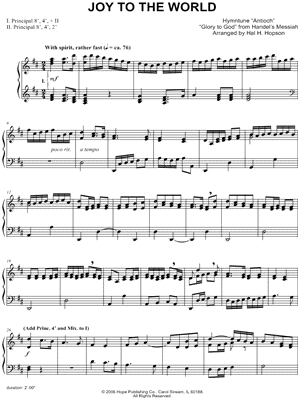

Notes for singers
If you place Joy to the World in a December service, a school program, or a living room sing, teach Antioch before you add harmony. A confident melody lets guests enter on the refrain. Say the names when you introduce it. The words are credited to Isaac Watts, and the music to Lowell Mason. The year to remember is 1719, and the place to name is England.
This sits in the library as a hymn. Let that tradition set the tempo. A lullaby loses its point if it is hurried. A dance carol loses its point if every syllable is precious. Leave a breath at the end of the verse so the next line feels chosen rather than chased.
Isaac Watts published the text in 1719 in The Psalms of David Imitated, as a Christian paraphrase of Psalm 98. Hold that fact in the introduction you speak, not only in a program note. The original heading presents the Messiah's coming and kingdom, not a manger scene. Those two details give a listener a reason to hear the song as a made thing, not as wallpaper.
When the group is small, one voice can carry the verse and everyone can take the refrain. When the group is a choir, decide in advance whether you are telling a story or painting a picture. Story songs want clear words. Picture songs can bloom. Joy to the World will tell you which it is after a single unaccompanied read through.
Questions readers ask
No. Watts published the text in 1719 in The Psalms of David Imitated as a Christian paraphrase of Psalm 98, under a heading about the Messiah's coming and kingdom. There is no manger, no star, and no shepherds. Churches later placed the hymn in Christmas services because the Lord is come fits the Nativity feast. A full reading still sounds like a song about Christ's reign in every season, which is why some hymnals keep it among general hymns.
Lowell Mason published the tune he named Antioch in 1836 in Occasional Psalm and Hymn Tunes, and he set Watts's words to it. A similar form appeared in The Modern Psalmist in 1839. Mason wrote that the melody was arranged from Handel. Scholars treat that credit as weak. A turn of phrase may remind a listener of Messiah, but the carol tune as sung now is Mason's, not a Christmas movement Handel composed.
Psalm 98 calls the sea, the rivers, and the hills to rejoice because the Lord comes to judge the earth with righteousness. Watts keeps that choir of nature and names a king and Savior. He also writes that blessings flow as far as the curse is found, bringing in the thorns of Genesis. The repeated wonders of his love are his closing praise. The hymn is joyful because a reign of truth and grace has arrived, not because the season is decorative.
They mention him because Mason printed a Handel credit in 1836, and because one musical gesture resembles Lift up your heads in Messiah. The resemblance is not enough to make Handel the composer. Careful study calls the link weak, and honest sheet music should name Mason for Antioch and Watts for the words. The legend survived because a famous name is sticky. The song itself does not depend on it.
Why this song endures
The hymn lasts because the opening sentence is almost impossible to forget and because the tune rewards a large group. Watts had a gift for the first line that teaches the rest of the stanza. Mason had a gift for a melody that repeats without becoming cheap. Together they gave English speaking churches a piece that feels like celebration and still carries a whole psalm's theology if anyone will sing past stanza one. The weak Handel legend has not hurt it. People do not sing Antioch because they believe Handel wrote every note. They sing it because the notes fit the words in the mouth.
It also lasts because Christmas adopted it without owning it. A hymn about the Lord's coming can serve December and can serve many other Sundays. That flexibility kept it in print when narrower carols dropped out of fashion, and the December habit then made it famous to people who never open a psalter. The honest history is easy to tell and does not diminish the song. Watts paraphrased Psalm 98 in 1719. Mason published Antioch in 1836 and suggested Handel on thin evidence. Churches later made the piece a Christmas hymn. The joy in the text is still the joy of a reign, not the joy of a shopping season.